
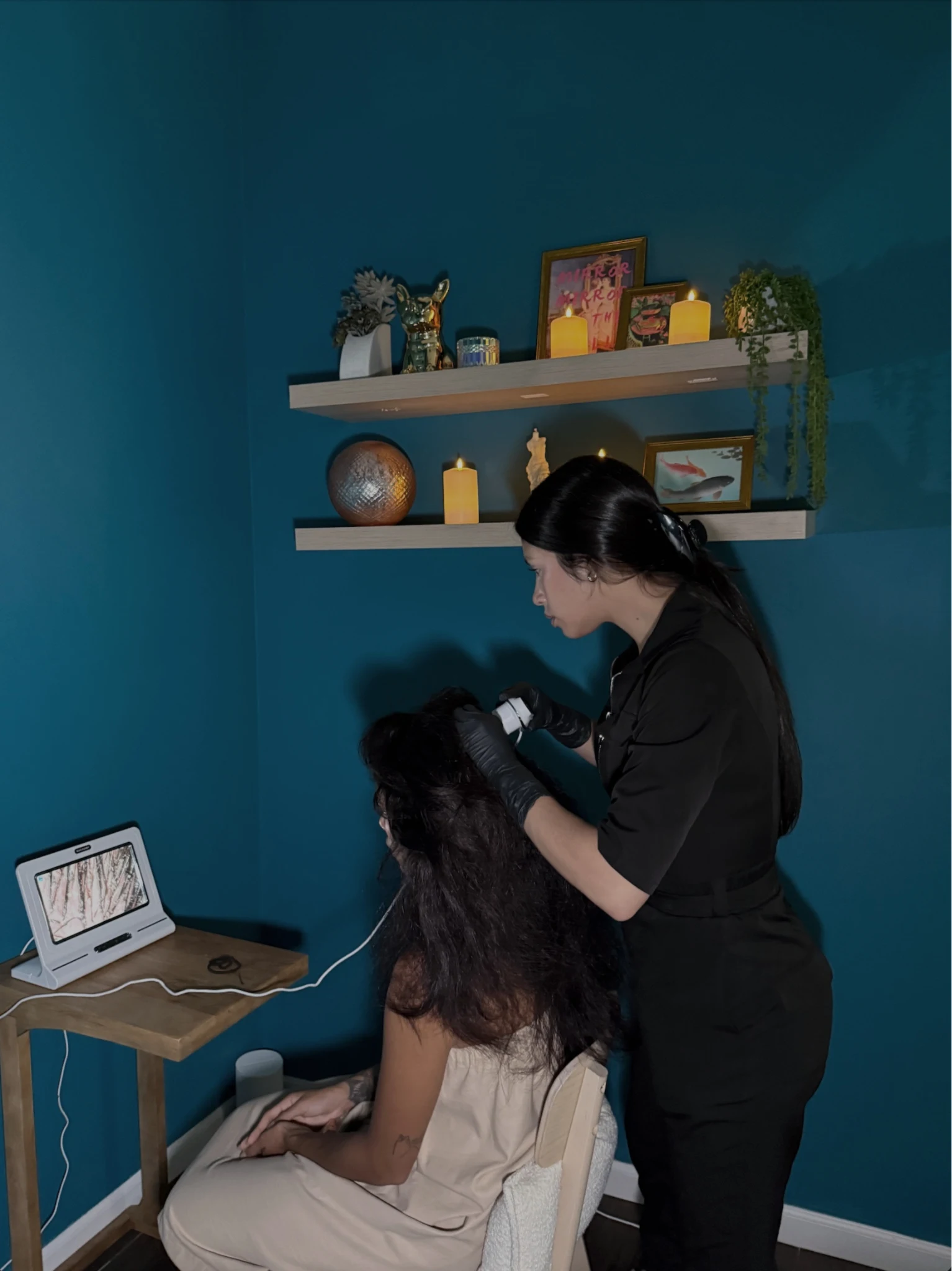

When starting a head spa business, the treatment bed and water ring are the visible investments. The harder decisions concern how many clients you can serve, how demanding the work is on your body, whether your space can support the equipment, and how clients leave after the treatment.
These decisions affect your pricing, staffing and daily operations. Here are five things new head spa providers underestimate—and what each one means for your business.
1. One provider, one client, one station
Some salon services include processing time that allows a stylist to work with another client. A head spa appointment built around cleansing, rinsing and manual massage requires the provider’s attention through most of the service. You cannot build your booking forecast around the same overlap.
The capacity limit: A second treatment bed does not double your bookings unless you also have the provider coverage to use it. Your practical capacity depends on staffed stations, appointment length and the time needed between clients.
For example, a 75-minute appointment plus a 15-minute room reset occupies a 90-minute booking block. Six available treatment hours accommodate four appointments for one provider. That is before allowing for any breaks or duties outside those six hours. Pricing the service as though you can fit six clients into that window creates a gap between projected and achievable revenue.
What to plan: Time the complete appointment, including consultation and finishing, then measure cleaning and setup separately. Calculate daily capacity from that total. Base your pricing on realistic bookings, provider pay, room costs, products and laundry. An extended massage or mini facial also takes time away from the next available appointment; account for that when pricing add-ons.
2. The physical demands of repeated treatments
A bed can be comfortable for the client and poorly suited to the person working at the basin. Shampooing, repeated massage movements and reaching around the head become a different workload when you repeat them across several appointments.
The equipment problem: A basin positioned too far from the provider encourages reaching. A working height that does not suit the provider can mean leaning forward or lifting the shoulders throughout the treatment. Limited legroom can prevent a comfortable seated position. These are working conditions you will repeat every day.
What to check before purchasing: Test access to the entire scalp, the distance between your body and the bowl, space for your knees and stool, and the location of products and controls. Check whether the bed or your working position can be adjusted for different team members. A setup that works for one person may not work for another.
Rehearse the full service in that position, rather than judging the equipment after a few minutes. Include provider breaks in the schedule. Good technique and a workable setup need to support the number of appointments you intend to sell.
3. A relaxed client still needs a finished service
The water treatment may be over, but the appointment is not complete when the client sits up with wet hair. They may be returning to work, meeting someone or continuing their day. Drying cannot be an improvised decision at checkout.
The operational gap: Hair drying requires time, space and, depending on your service model, another person. If the same provider performs a blowout, that time belongs in their booking block. If another stylist finishes the hair, their availability must match the head spa schedule. A separate drying area can free the treatment station, but only if the handoff and staffing are planned.
Choose your finish before launching: Offer an included basic dry, a properly equipped self-service drying area, or a separately booked professional blowout. Explain exactly what is included and what costs extra. A basic dry and a styled blowout should not be presented as interchangeable.
Allow for differences in hair length, density and texture. Clients should have a clear way to leave with dry hair, without an unexpected fee or a last-minute scramble for a dryer. Finish with relevant aftercare while preserving the calm pace of the appointment.
4. The plumbing and maintenance behind the equipment
Buying a head spa bed does not establish that your space can run it. Water supply, drainage, electrical requirements and maintenance need to be checked against the specifications of the actual model you choose.
Avoid choosing an unplumbed head spa bed simply to skip installation costs. These units require manual filling, wastewater disposal and tank cleaning, which add work between appointments. Their acceptability also depends on local plumbing and sanitation requirements.
The questions that matter: Does the unit use a continuous fresh-water supply, a recirculating system or refillable tanks? What water pressure and hot-water supply does it require? Where does wastewater go? What happens to performance when another station is running at the same time?
A single successful demonstration does not prove that the setup can handle back-to-back appointments. Have the installer assess hot-water capacity and recovery, drainage and simultaneous demand. For a tank-based system, include filling, emptying and cleaning in the workflow.
Maintenance is part of capacity: Before buying, obtain the cleaning instructions, water-quality requirements, maintenance schedule, warranty terms and replacement-parts information. Check how accessible pumps, filters, hoses and other serviceable components are. Follow the manufacturer’s instructions for steamers and water systems rather than assuming every device uses the same water or cleaning method.
If equipment stops working, the cost can include interrupted treatments and canceled appointments as well as the repair. Technical support and parts availability belong in the purchasing decision alongside appearance and price.
5. Head spa needs to be developed as a specialty
A water ring creates a recognizable visual, but it does not establish the quality of the service. The experience depends on the provider’s assessment, product choices, manual skills and ability to deliver a coherent treatment.
The service gap: Adding equipment to a standard shampoo station leaves important questions unanswered. How will you assess the client’s scalp and discuss their concerns? Why are you choosing a particular cleanser or mask? How will you adapt the treatment? What will the client experience between each stage?
Product knowledge needs to extend beyond memorizing names. Providers should understand each product’s purpose, application instructions, timing and suitability. Treatment flow should be practiced until products, tools and transitions are organized—not interrupted by searching for supplies or deciding what comes next.
The environment also has to support what you advertise. If you promise deep relaxation, consider nearby conversations, ringing phones, blow-dryer noise, lighting and privacy. A head spa inside a busy salon needs a deliberate plan for managing those distractions.
Build the service before promoting it: Establish your consultation process, treatment sequence, product selection, room setup, drying options and aftercare. Then train the team to deliver those elements consistently. That is what gives a specialty service substance beyond the equipment.
Learn to build the complete head spa service
NIKA Head Spa Certification connects treatment technique with equipment, product knowledge, preparation, drying and the business decisions behind your menu. The goal is to help you understand how the service works from consultation through the client’s departure.
Explore NIKA Head Spa Certification to develop your skills and plan a complete professional head spa experience.